
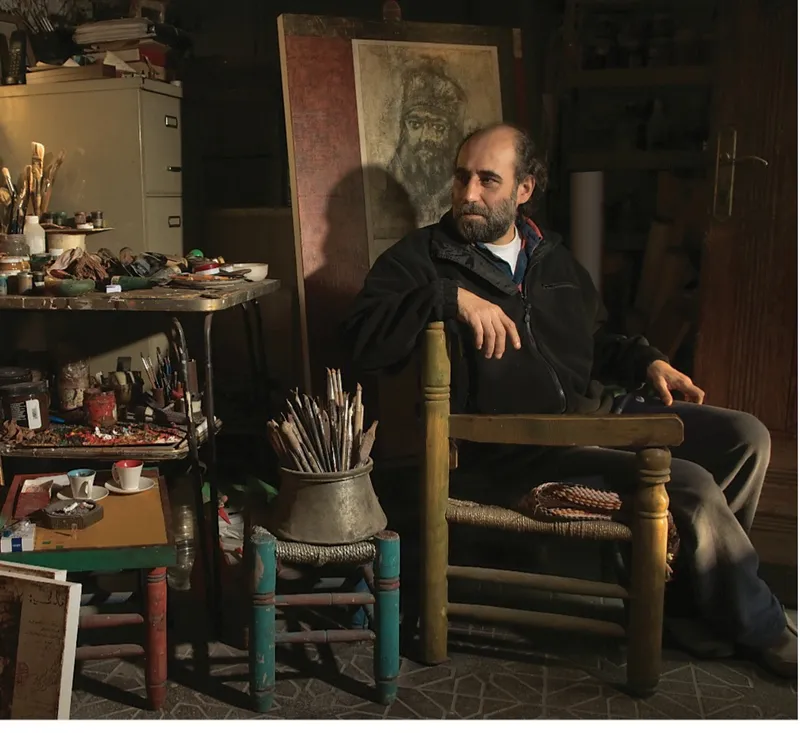
George Baylouni: Bridging Civilizations Through Symbols and Paint
Born in Aleppo in 1966, George Baylouni came of age amid Syria’s rich artistic and historical tapestry, one deeply rooted in the legacy of Mesopotamia, Assyria, and Phoenicia. But like many of his generation, Baylouni’s life was upended by war. In 2014, as Syria descended into civil conflict, he left Syria to France, leaving behind not just his homeland but the studio walls that once held his earliest works.
Today, Baylouni’s practice is shaped by displacement, memory, and a relentless search for unity across cultures and epochs. From his studio in Tours in France, a former children’s prison turned creative haven, the Syrian-born artist creates paintings and collages that are at once deeply personal and universally resonant. He weaves together religious iconography, ancient symbols, and contemporary techniques, often gilded with gold leaf, a material that has become his visual signature.
Baylouni’s fascination with the ancient world, particularly the enigmatic codes of cuneiform and the visual language of early civilizations, forms the backbone of his artistic inquiry. Yet his work refuses to remain in the past. His canvases speak to modern tensions and aspirations, placing Christian and Islamic motifs side by side in an act of visual diplomacy.
“Humanity can only thrive when we embrace diversity and differences regardless of race, creed or color,” Baylouni says. “When I combine the symbols of different civilizations in my paintings, I convey my faith in the unity of humanity. This is my message to the world, irrespective of time or place.”
This belief, in time as a unifying force, and art as a vessel of shared memory, defines Baylouni’s philosophy. His work often returns to three conceptual pillars: time, walls, and symbols. Time, he explains, represents “the shared memory on the scale of humanity.” Walls serve as surfaces of witness, layered with wallpaper and pigment, echoes of lives lived and voices silenced. Symbols; religious, cultural, geometric, form the connective tissue. “The artist,” he says, “is the one who unifies symbols with humanism.”
Beside exhibiting in Syria, Lebanon, Kuwait, France, and Germany, his exhibition in London, Symbols of Humanity, marked a significant moment in a career that has spanned decades and continents. His work has been exhibited across Europe and the Middle East, and in 2014 he was named one of the 100 most influential Arab personalities by Arabian Business magazine. In 2020, his painting Dualité was the first to appear at auction, at Rouillac Vendôme.
A visit to Baylouni’s studio reveals the warmth and humility behind the work. Soft-spoken and affable, he relies closely on his wife, who is often at his side, in life and in art. Their partnership is as integral to his creative process as his historical references. Together, they welcome guests with homemade coffee and quiet stories of Aleppo, as if it were still just a short drive away.
He recalls, without drama, how he once smuggled paintings across the Syrian-Lebanese border in furniture trucks to avoid ISIS checkpoints. He speaks of the past not with bitterness, but with an abiding sense of wonder, for what was lost, and for what art can still restore.