
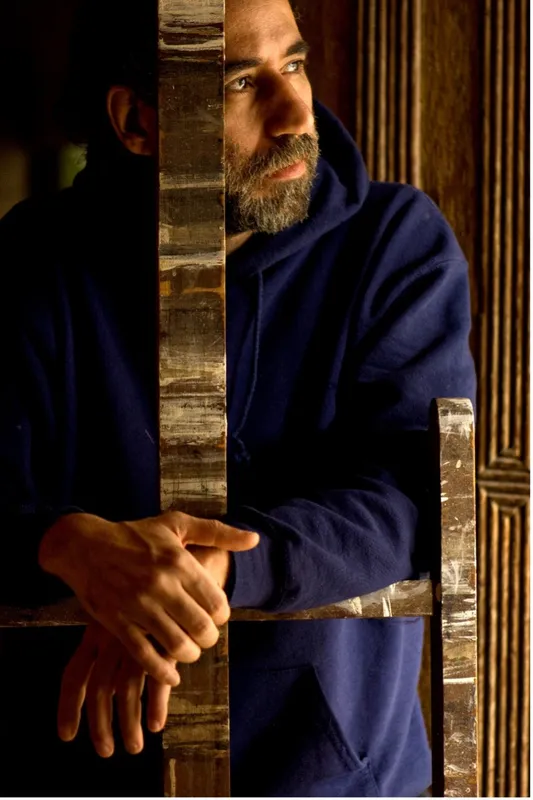
“My canvas might contain everything; memory, politics, architecture, personal grief, joy. Even if the artist is removed from the world while working, the world is always in the work.”
The Timekeeper of Aleppo
In Conversation with George Baylouni
When speaking with George Baylouni, one gets the sense that time itself is his true canvas. Born in Aleppo in 1966, the Syrian-born artist now lives and works in Tours, France, a city where medieval stone meets modern industry, not unlike the way Baylouni’s paintings merge ancient civilizations with contemporary realities. His work, a hybrid of symbol and silence, often feels less like a declaration than an excavation, a quiet search for continuity in an era of fracture.
Baylouni left Syria in 2014 as war engulfed the country. But long before the violence, he had been listening, to the layers of history in old Aleppo, to the voices of its muezzins and church bells echoing across neighborhoods, to the smell of the earth after the season’s first rain. These, he says, are his earliest influences, not objects, but atmospheres. “The cracks in the walls,” he tells me, “carried the weight of time. They told stories before I knew how to.”
In the studio, a former children’s prison turned art complex in Tours, France, Baylouni works across multiple canvases, often at once. His technique requires layering, drying, and returning. “At a certain point,” he explains, “I can focus only on one painting. The others must wait.” Each work is part of a broader conceptual project, rarely born from a title or theme, but instead shaped by a sustained internal vision. Titles come later, if at all.
His materials are eclectic, pulled from both environment and experience: acrylics, collage, fabric, natural dyes. The physical layers in his work mirror the philosophical ones, religious symbols overlap, Christian and Islamic calligraphy coexist, history rubs against memory. And always, that signature glint of gold leaf, less for its opulence than its timelessness.
Baylouni draws inspiration not just from artists but from epochs. “The first caveman who painted on a wall,” he says, “was the first to create wonder. That wonder is still with us.” Later influences include da Vinci’s manuscripts, the chiaroscuro of Rembrandt, the vaporous skies of Turner, and the raw textures of Antoni Tàpies.
Though deeply rooted in history, Baylouni’s practice is anything but nostalgic. It is tethered to the present by both feeling and form. “My canvas might contain everything; memory, politics, architecture, personal grief, joy. Even if the artist is removed from the world while working, the world is always in the work.”
The act of painting, for Baylouni, is both deliberate and organic. He begins with a conceptual project, but emotion is never excluded from the process. “It’s not how long a feeling lasts,” he says, “but how deeply it imprints.”
He works to music, never in silence. “Fado,” he says, referencing the Portuguese genre known for its melancholic beauty, “holds that perfect balance between East and West.” It’s the same balance he seeks in his work, fusing civilizations into a visual dialogue. “My goal,” he says, “is human unity. Through form, through symbol, through art.”
When asked about the first time he touched a paintbrush, Baylouni recalls a fishing trip with his father. He was six. Among the men was the painter Hazkiyal Toros, who brought along his easel and paints. “That was my first surprise,” Baylouni says. “Colors, brush, canvas, something magical was being revealed to me in nature.”
Over the years, his style has evolved, as most do. “But I’ve always held onto my identity,” he says. “An artist must explore, yes. But they must also be recognizable to themselves.”
As for the role of the artist in society, Baylouni’s answer is quietly insistent. “Art is not an accessory to life. It’s part of its foundation. As necessary as economics. As vital as politics. Without art, how do we reflect? How do we dream?”
Ultimately, he resists placing his identity in any one form, color, or medium. “My identity,” he says, “is in the project. Everything else, materials, gestures, techniques, serves that idea.”
For Baylouni, art is not therapy, nor escape. It is articulation. It is a way to inhabit time without being broken by it.