
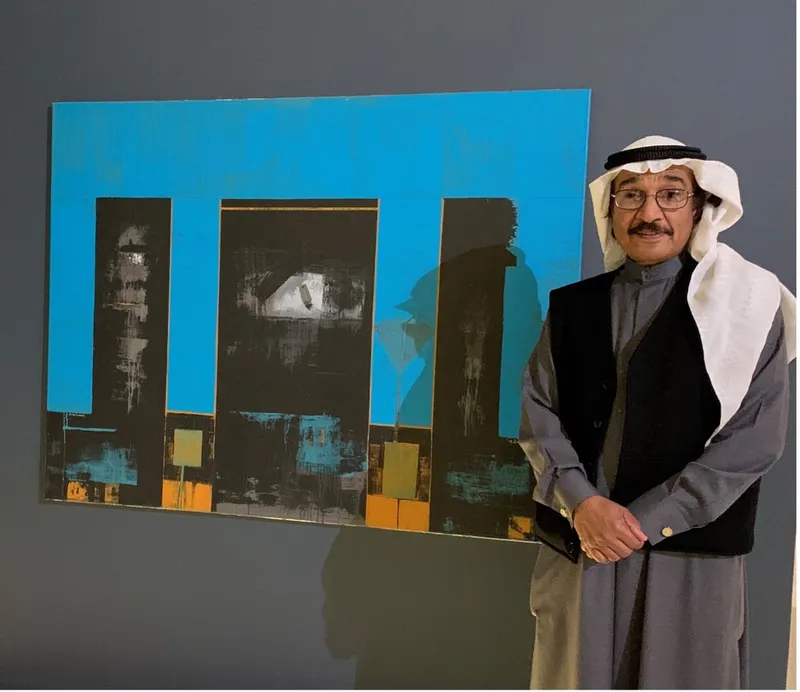
“Identity is not a single form. It’s the sum of your culture, your place, your experience. We learn from others to become ourselves. Our task is to carry our history into the future, but through our own language.”
In Conversation with Abdulrahman Alsoliman
The Saudi artist reflects on childhood ink pots, the burden of titles, and why painting still starts with memory.
In the courtyard of his childhood home in AlAhsa, Saudi Arabia, a young Abdulrahman Alsoliman once painted a wall red, vivid, wet, and, for reasons he still doesn’t fully understand, stubbornly slow to dry. He was in sixth grade, the family had just moved, and before the white paint came in, the wall became his first canvas.
“I remember that brush,” he says. “It was wide. I covered about a meter of space with it.”
Today, Alsoliman's name is etched into the foundation of Saudi Arabia’s modern art scene. A painter, writer, cultural commentator, and editor, he has spent over five decades shaping both the image and discourse of contemporary Saudi art. His work is a deep personal fusion of memory, architecture, and abstraction, has been exhibited across the Arab world, Europe, and Asia. But his practice, he insists, remains rooted in a quieter place: a boy with a dip pen, grinding his own ink in the classroom of AlKout Elementary School.
“We made ink at home; black powder, mixed with water in an inkwell,” he recalls. “We dipped cotton inside so it wouldn't run. That was how we learned Arabic calligraphy.”
Calligraphy, school wall newspapers, neighborhood murals; these were the early seeds. At one point, he and a classmate even fantasized about opening a calligraphy shop. “That was just a childhood dream,” he says with a smile, “but maybe it says something about how much we loved the letters.”
On Process: “The Work Paints You Back”
Alsoliman is not one to jump between paintings. He prefers to live inside a piece, sometimes for hours, sometimes for weeks. He may return late at night, long after the day’s momentum has died down, just to see it differently.
“I revisit works in silence, away from the structure of time,” he says. “Sometimes I complete something, then let it sit. I might return to it later. Each moment reveals something else.”
Titles, he admits, are another story entirely.
“Naming a painting is a burden,” he says. “Some people enjoy poetic titles, but I often find them inaccurate. A work may come from multiple moments, different moods. A name tries to freeze something that has already moved.”
A Visual Language Forged in Place
When A-Room asked which artists have influenced him, Alsoliman says:
“My art comes from my life,” he says. “My first home in AlKout, the old streets of AlAhsa, the architecture, the rituals, the environment. I’ve met many artists, accompanied them, admired their work. But their art is theirs. Mine represents my place, my culture, my identity.”
His palette and materials reflect this groundedness. Over the years, Alsoliman has worked with everything from oil and gouache to palm fronds, fiber, and cardboard. In the late 1990s and early 2000s, he exhibited mixed-media pieces that included natural elements and local materials imbued with memory and texture.
“I painted with Chinese ink, posters, pens, acrylics, palm fibers, even mats,” he says. “Whatever the moment called for.”
On Inspiration: "Begin with the Desire"
His approach to painting is rarely premeditated. “Desire comes before idea,” he says. “The urge to paint opens the door, and from there you find your way; whether it’s through a memory, a shape, a problem to solve.”
That sense of intuitive risk runs deep in his philosophy: “The important thing in the artistic process is the courage to take risks. The work we produce is us. And it’s always subject to change, especially early on.”
Time, for him, is elastic. A painting might take days or years. “There’s no set time,” he says. “It depends on the work, the artist’s mood, the materials, the moment.”
On Sound and Silence
While Alsoliman occasionally listens to music while painting, most often classic Arab singers like Umm Kulthum, Abdel Wahab, or Talal Maddah, he’s quick to add that many creative moments demand silence.
“Music is good when you're solving technical problems. But for memory, for emotional work, I need quiet. That’s when I’m alone with my days.”
On Style and Change
His early works were direct: farms, palm trees, and traditional homes drawn from memory. Later, geometry and abstraction entered the frame, not as imitations of Western cubism, but as deeply personal reinterpretations of form.
Pieces like A Swab on the Head of an Orphan (1980) and Worshippers Leaving the Mosque (1981) became vehicles for memory and meaning, filtered through a structure that was uniquely his.
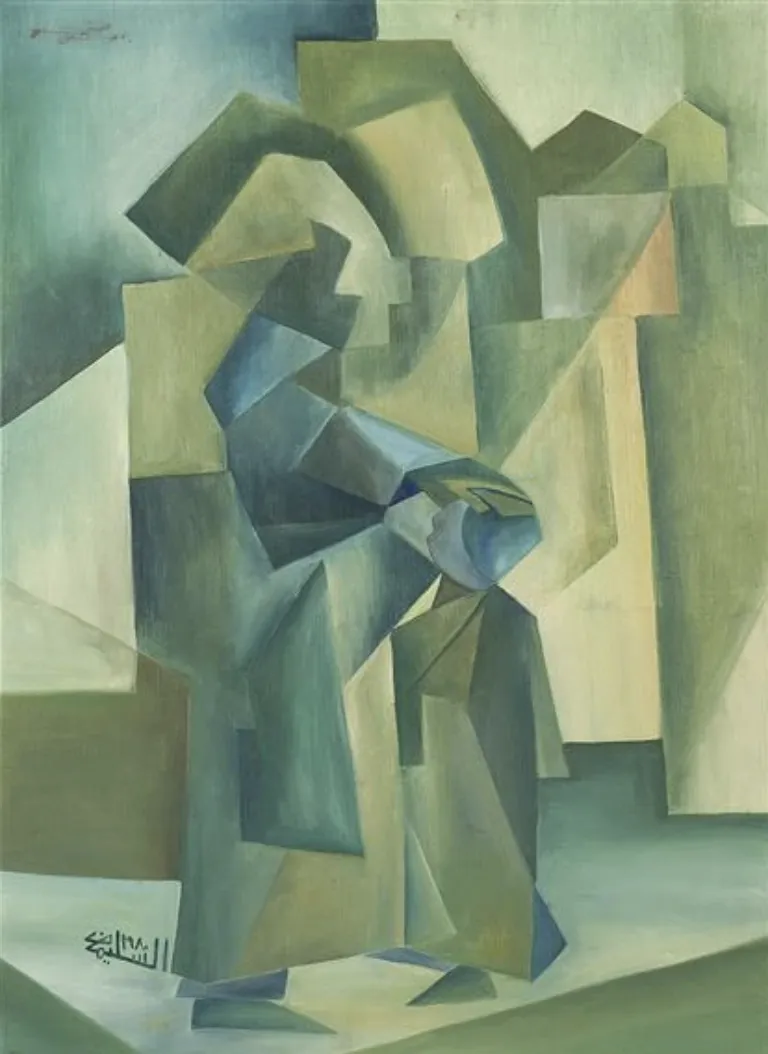
“Even my geometric work comes from the traditional scenes I carry within me,” he says. “But I sought freedom, not imitation.” Through the ’80s and ’90s, Alsoliman experimented with ink, printmaking, and engraving. Each phase informed the next.
On the Role of the Artist
For Alsoliman, the artist is not merely a creator, but a participant in public life, an interpreter of culture, a keeper of memory, a contributor to discourse.
“When artists are given space through museums, exhibitions, publications, or even curricula, their impact grows,” he says. “I’ve written about art for more than forty years. I’ve published five books, with a sixth on the way.”
Beyond his writing, he offers mentorship and consultation, participates in local and international panels, and supports graduate students and young artists across the Kingdom.
On Artistic Identity
When asked how he defines his artistic identity, Alsoliman answers without hesitation:
“Identity is not a single form. It’s the sum of your culture, your place, your experience. We learn from others to become ourselves. Our task is to carry our history into the future, but through our own language.”
On Emotion and Memory
For Alsoliman, no painting exists outside the self. Feelings, memory, personal history they’re not just influences; they’re inseparable from the act of creation itself.
“The work includes everything: who we are, what we remember, what we feel. Art is emotional. You can’t fake that. When it's natural, when it's not forced - that’s when it speaks.”
Abdulrahman AlSoliman continues to live and work in Dammam, Saudi Arabia. His works are part of public and private collections, including the Barjeel Art Foundation (UAE) and the King Abdulaziz Center for World Culture (Ithra). His paintings, like his words, trace the lines of a place he knows intimately, and still seeks to understand.