
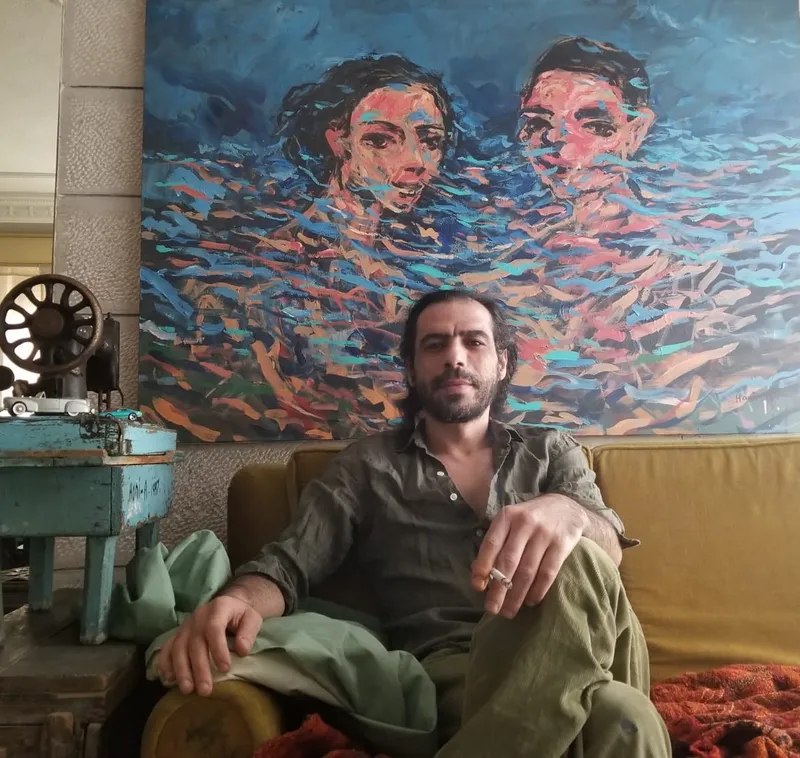
“I’m chasing truth, whatever shape it decides to take.”
In the Studio with Hani Alqam: Painting Memory, Chaos, and the Human Pulse
In a quiet studio in Amman, surrounded by thick swaths of paint and half-finished canvases, Hani Alqam moves between works-in-progress with the unhurried rhythm of someone who understands that art is less about arrival and more about return.
The Jordanian painter, whose expressive, often densely layered portraits and cityscapes evoke both the psychological weight of human experience and the fractured beauty of urban life, doesn’t treat each canvas as an isolated gesture. “I usually work on more than one painting at the same time,” he tells me. “I don’t think of a painting as a beginning or an end, but as part of something continuous. The old always finds its way into the new.”
Born in Amman in 1977, Alqam remembers an early fascination with cartoons, not for their narratives, necessarily, but for the imaginative spaces they opened. “They were my first gateway to art,” he says. “I started to draw worlds I couldn’t find around me.” He never made a conscious decision to become an artist. “It was more like something that quietly unfolded. A path I naturally walked down.”
Alqam's work often blends personal memory with a keen sensitivity to the world’s harsher textures: war, injustice, human frailty. These themes appear not as overt statements, but as embedded emotional undertones. “Sometimes the influence comes from memory,” he says. “Sometimes from the present. I don’t plan it. The images find their own way out.”
When I ask if he begins a painting with a clear idea, he said: “Painting is a form of thinking. It’s how I deal with feelings that are difficult to put into words.” Those feelings ephemeral, visceral, deeply human find their way into every brushstroke. “My thick paint and strokes are a kind of compilation,” he explains. “Stacked thoughts and desires, unraveled.”
Despite the intensity of his themes, Alqam doesn’t approach painting with solemnity. Music, particularly Arabic classics by singers like Warda and Mayada El Hennawy, fills his studio as he works. “There’s something emotional and familiar in those old songs,” he says. “Sometimes I even play things I listened to as a child. It keeps me grounded in something private.”
Naming a finished piece, however, is a quieter process. “Most of the time, the name comes after. I let the painting express itself first, and then I try to choose something that resembles it, something that doesn’t interrupt it.”
Alqam has long been drawn to painters who, like him, found expression in human complexity rather than perfection. He cites Rembrandt, Goya, and Chaim Soutine as early influences, not just for their painterly techniques, but for their unflinching portrayals of the human condition. “It wasn’t their style that moved me,” he says. “It was the feeling - the emotional truth beneath the surface.”
That emotional truth has guided Alqam across different materials and modes of working. While he often uses oil and acrylic, he has also incorporated found objects into his canvases, fragments from daily life that, in his hands, become carriers of deeper meaning. “Sometimes, a material says what color or shape cannot.”
Over the years, his style has not so much changed as matured. “It’s evolved with me,” he says. “It’s like we’re walking in step, my style and I, but sometimes it’s one step ahead.”
For Alqam, the artist’s role isn’t to provide clarity or comfort. “We don’t give answers,” he tells me. “We ask questions. We look at what’s left unsaid, and we offer a visual impression - one that stirs something in the viewer.”
His own identity as an artist, he believes, lies not in any specific technique or motif, but in the emotional honesty of the work. “I’m not chasing a style,” he says. “I’m chasing truth, whatever shape it decides to take.”
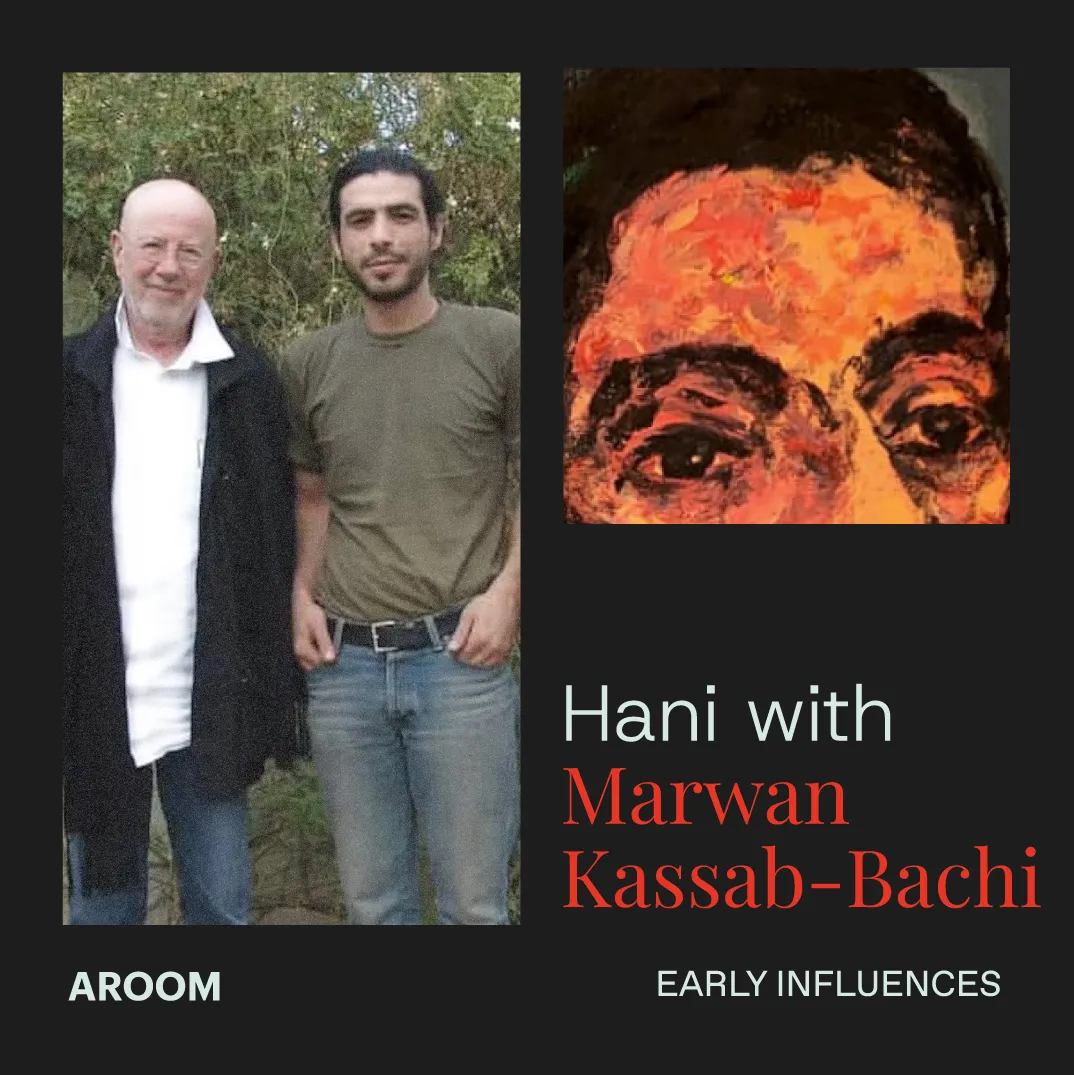
AROOM asks him if there’s someone from his past he wishes he could speak with again. His answer is immediate: Marwan Kassab-Bachi, the late Syrian-German painter known simply as Marwan. “He was a friend and a teacher,” Alqam says. “He taught me something essential; the philosophy of freedom in art.”
And maybe that’s what underlies Alqam’s work most of all: a search for freedom; not just in the world, but within the tangled spaces of the mind, the city, and the self.